Monday, 20 June 2016

Reflections of a coach, teacher and educator 1

What have I learnt so far? That is a deep question isn't it? There are things you learn that apparently skim the surface but only come back to hit you between the eyes, years down the line. There are other lessons that have an immediate impact, shake your roots and foundations of belief and ideology. There are other ideas that you do need to sit and think on. Let us say for about 25 years and counting!

Lesson 1  Context is everything

Setting up the conditions to learn are as important as the content.  What do we mean by conditions? Context is everything and the student needs to hear a deep appreciation of their own context, needs and a reflection of the direction they wish to go.  Basically, they need to feel understood. By achieving this the coach is in a far better position to offer suggestions and possible directions for the student to experiment in the session and also, have the confidence to give it a go and practice away from the session.

Lesson 2 A practice mind is different 

A practice mind has a different root. It is an 'in the moment mind', a 'one-pointed mind', a 'beginner's mind'. Or as the Zen Buddhists say 'shoshin'. This beginners mind is not a simple state of forgetting all one has practised but a statement as to how we all need to keep things fresh every time we do practice. We are always open to suggestions, experiences and feelings. Not clouded by judgement or arrogant thoughts. 

Practice with precision, do not count but practice awareness and heighten the sensation of connective experiences.


Wednesday, 21 November 2012

Airscape

I was reading an article by John Kabat-Zinn and I was struck by several key observations but the one I wish to discuss briefly today is the idea of 'Airscape'. 

We are all very comfortable with the notion of 'Landscape' and idea of seeing some beautiful vista projected into our eyes.  In a simple way we 'take it all in'.

Airscape is a notion of taking in and being aware of the air around you as you move, breath and , of course, run. We are, after all, moving under a sea of air and gaining a real sense of this life giving mixture permeating inside and around us is a very relaxing way to look through the world.

Danny Dreyer of chi living also points to having a centred approach to your movement, physical and mental. What he points to is allowing your fullest attention to be brought to the 'Dan Tien' centre (3" below your naval) and moving this first as you initiate any level of interaction.  Clearly linking this with breathing through your centre and an awareness of 'airscape' gives a sense of stability and inner calmness.

This thinking and approach is now part of my running mind. Using holistic images and penetrative thoughts keeps me grounded.

I do meet runners who seem form pre-occupied to the point of being distracted. I get this point completely but finding the moment in every moment requires a different thinking, try it and see what it does for you?

Saturday, 11 August 2012

improve by 1%

We can all improve every aspect of our lives! It can, however, feel so daunting to be asked to improve, and anyway what does it all really mean?

'Why should I improve? I am happy who I am, content living in the mainstream and no sense of dread, unhappiness, life is good for me! I earn well, have a good life and give generously, no-body has really complained about me :) .'

 In this context what is improvement??  I think we can answer this by looking at one of the key core principles of chi running namely a practice orientated approach. In Matthew Syed's book 'BOUNCE' he uses a key phrase namely 'purposeful practice'.

The  key issue with a practice is a sense of progress and improvement no matter how small.  Descarte uses the term 'soft machine' as a description of the human system;  this is entirely true as we are an organic and, sadly, dying animal that needs to constantly look at the working of our machine and apply changes such as feeding, exercise, cognitive and emotional inputs  to ensure our system is in balance.


So if we do not focus on improving our lives then perhaps we fall into emotional, physical and cognitive entropy. That is, we simply fall apart and use less and less of our internal systems and end up existing in the basic sense.


Wednesday, 20 June 2012

Rest quietly

I have read two very interesting books over the recent weeks, namely 'More fire' by Toby Tanser and 'Running with the Kenyans' by Adharanand Finn both were focused on the secret of the Kenyan running success. I could go on about a lot of interesting issues that were raised in these books but one of the things that stood out for me was the amount of rest the elite Kenyan runners had during the day, in between runs, and after major events.

This is very unlike the cross training military regime that some of the British Athletes undergo in their training, where, after a run, they go straight to the pool for 70 lengths and then gym work after that!   This made me think about rest or a better term 'quiet time'.   This distinction is not just a play on terms but  a fundamental attitudinal change to 'rest'.

For a long time Biologists who were studying the division of cells during the beginning of life could not understand the time lag between each cell division. On a cell level there did not seem much going on between each division cycle. Yet they made the important discovery that at the molecular level the 'quiet time' between division was where the re-ordering of DNA occurred.  This re-ordering of the next transition between two states was as vital as the division itself. Just because you could not measure it did not mean it had no value!

So, on a micro level it appears that a quiet time is required not only for replenishing energy supplies but also to align and direct DNA.  At the Macro level I have found over the years that a quiet time is needed by the brain to allow aligning up of physical and mental experiences.  How many times have you woken up with a realisation or an insightful thought that helped you solve a difficult issue or problem ?

Chi Running, Yoga and other mindful practices make a distinction about allowing the sub conscious and conscious mind to 'yoke', align and respond.  This cannot happen in a state of mind that is receiving inputs from external sources creating stimuli that your brain needs to respond to.  Allowing your mind some quiet time gives the body a chance to make sense at a micro and macro level. We all have had the insightful moment when our mind was not, apparently, thinking about a problem or concern and yet we see the solution with clarity and resolution.

I cannot stress enough that purposeful practice and rest is very different to 'down time' or recreational time.

So next time you rest make sure it is a 'quiet time'.

Monday, 4 June 2012

'Playing slowly is key' Mozart; Music, the mind and running

'When I do not practice for one day, I notice, if I do not practice for two days the audience notices'.


It is reputed that when composers visited Mozart for lessons, his first instruction was to ask the composers to write out all the scales! (if you are a musician, you know that there are a lot of scales to learn), insulted, but daring not to challenge the maestro they began the task.  People assumed that Mozart had some secret knowledge but this was not the case, the notes were the same, scales the same but his knowledge ran deep, connections made between areas of expression and areas of composition. Could you really have  a lesson with a genius and become a better composer? What Mozart was getting at was clear; know the fine detail, know the basics, without these then the building you construct through your knowledge is poor, out of sorts and not connected.  He is also reputed to have said;

 'it easier to play fast than it is to play slow, you can make mistakes playing at speed and no-one notices but is that music?


The two quotes combined give an insight as to what mastery is and how we need to ensure that our efforts are directed to maximise our talent; the first quote is about  recognising the need for practice every day; the mind is an amazing organ but the two examples cited above indicate that without practice, focus and purpose it loses it edge; you may for example (as an ex golfer) see a great shot and know exactly how to achieve it but repeating it is not the same; the  sub conscious mind has lost the connection between the conscious physical mind of choice and awareness. Physical activities such as swimming are the same, swimmers complete many lengths a day to help their body/mind connection between themselves and the water to be fully activated.  As an ex swimmer (as well:) )you lose the feel of the water if you are even a few days away from the pool.  Likewise running is not all about the hard runs or interval training; much training occurs on the long slow/easy days where you keep the mind sharp and concentrate on form.

climb with care:) 
Control, exertion, focus, alignment and one pointedness are at the heart of many creative things. I know Professors of Mathematics, Musicians, Artists and Authors; they all exude control; Controlling of your thoughts and giving it direction. Exertion; when to give the 'right effort'; Focus, the ability to bring into play all your abilities to solve, create or achieve.  Alignment, the idea that we need balance and harmony to maximise our impact and influence and finally One pointedness, that ability to scrutinise a key issue that matters.

So Chi Running is not bio-mechanical only, you can tell from my BLOGs the land where I come from but it is good to practice life affirming qualities that define who we are and learn a little of what it would be like to be a 'Mozart'.

Wednesday, 30 May 2012

How to decide, learn from the simple act of running

We make a lot of decisions during our busy lives, some seem more important than others; some get more attention whilst others simply get lost in the activity of busy-ness. Can you remember all the decisions you made today? Of course not! Some decisions I make occur in an instant; I am still a practising teacher and students throw issues and questions that require thought and action almost at the same time but not in any order. I repeat thought then action.

What we are really talking about, however, is  reflection in action and reflection on action. Both have resonance as a teacher, first if a student comes to you with a concern you should think about the possibility of establishing a connection and a learning opportunity. Simple responses give simple actions; my philosophy is to always try and empower students to think for themselves; the only way to do this is to rephrase questions and get them to see things in a different manner. This would be, for me, reflection in action. If I go away and think about the days activity and change or critically analyse my performance or learning experiences then this would be reflection on action. 


We run , at times , to get away from decisions, we run to flee from responsibility, to be free from the chains of life, people and stuff. You hear it reading certain running books, A sense of freedom. Of course we are not free and never will be; we are surrounded by decisions at all levels and we need to understand that we cannot escape being human. Being human is to be part of a community, a tribe with our own kin. We are judged not by running away or by being super fit but by how much we respond, listen and help others. Humility and quiet compassion are the tigers in our hearts.

I enjoy, however, making running decisions! It has helped me further in developing my decision making, thoughtfulness and mindfulness at all levels. I regard these decisions as 'sharpening my saw' and help support other decisions in my life, those that impact and influence other people for example. A nice and simple way of practising making decisions and about being observant is simply put your watch on 10 minute repeats; as you run observe everything around you, draw in the surroundings and focus on your internal sensations; chi running is excellent at creating a meditative platform to allow this refocus; as soon as the 'beep' goes for 10 minutes review your body and surroundings; what did you see? how did you feel? all workouts do not need to be a 'beasting session' some can be this deep balanced state of drawing and breathing in the external to the internal; just like a door, we should be able to move inside to outside with ease; no distractions, no tension, no feeling of being 'ill at ease'. 

About a week ago I decided on my run to extend it by another mile; why? well I felt good, it was extremely hot (25C) and it the extension would make me run on the coastal paths (ie cool breeze).  I could have laboured and continued running on a shorter, faster route away from the coast but learning to own decisions and owning your programme is empowering.  I felt good with the choice of route, content with the outcome and more balanced as I walked home from my regular cafe at the finish line:)

So decision making is easier if you are aware of what will be influenced by your choice, behaviour and/or plans.   All of this implies that you need to be a lot more observant of yourself, you cannot live your live by moving through it and not feeling each moment. Chi Running and walking are an excellent way to improve mindfulness, clarity and focus, develop fitness and give YOU the tools to own your life.

Saturday, 12 May 2012

The sleep of the Just

The above title was a phrase that was oft used by a very good friend of mine. He used to say it after we had a good walking and climbing day in Skye and a few beers:)  'and now for the sleep of the just' he would state in a pompous manner before we climbed the particularly steep sets of stairs at the 'Old school house' in Carbost.

 I  love sleeping in Scotland, (I know a bit weird, how can you look forward to a Holiday and think of the sleep?) in particular I remember one sleep (?) a few years ago that really made me think about the true benefit of mindfulness and yoga practice.


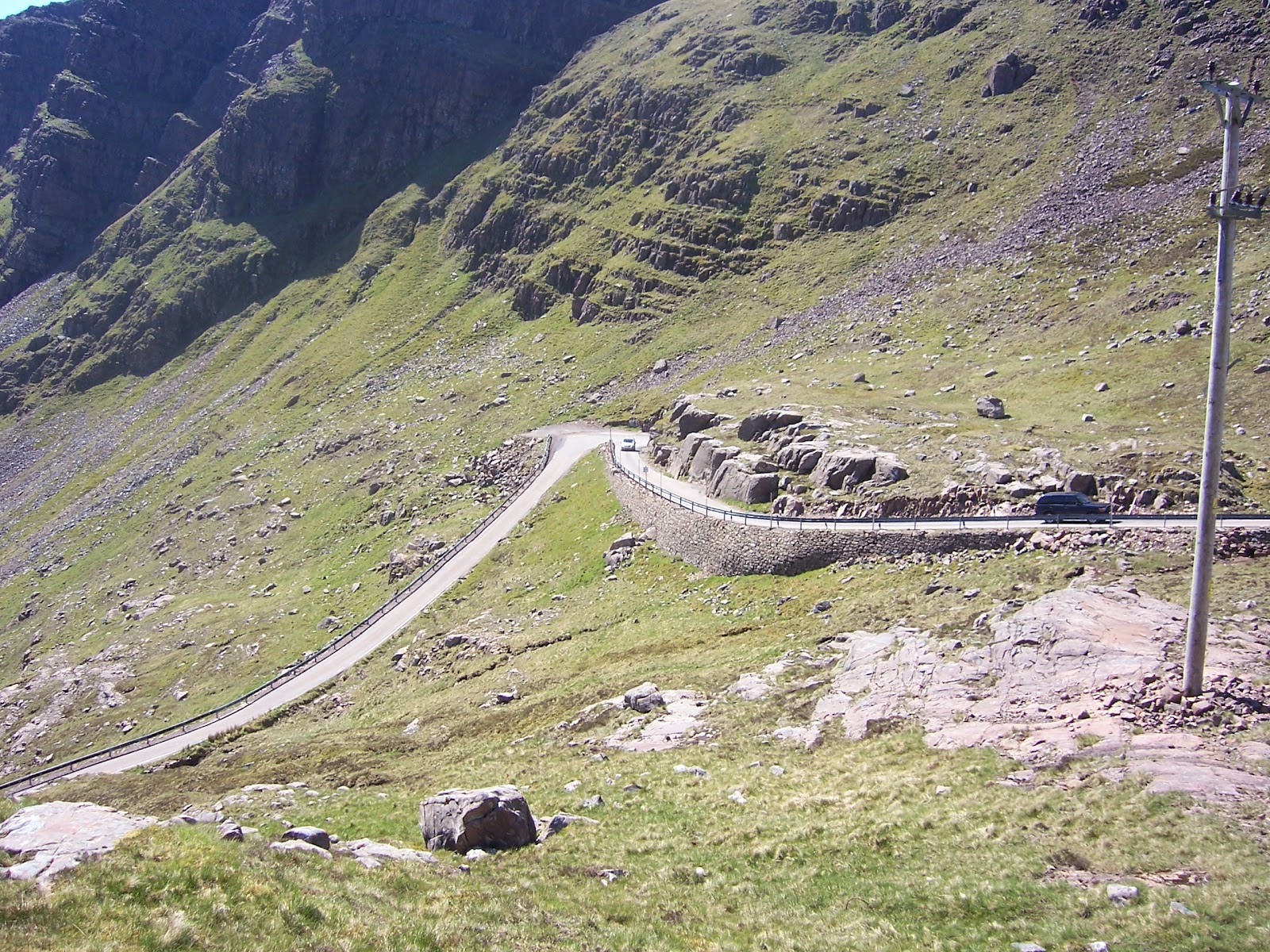
Road to applecross, it is tough
We were staying in a lovely village called Badachro, opposite Gairloch, on the west coast of Scotland;  that is ,me, Phil and his wife, my great mate Sid, and one or two others.  This particular day I decided to revisit my old cycle route and cycle around the Applecross Peninsula via the only way and that was to cycle over the Bealach-na-ba(photo) which is a mere 2000 feet of climb over 6 miles. I will not go into the details here but I had a 'grand day out' on my tod and we all met up back at the Badachro Inn for a few tales and share the days exploits.


it is a bit steep this Road to Applecross
These pictures are not any old pictures, oh no these are THE pictures of the night before the SLEEP.    I can hear you thinking, 'Nick was a bit worse for wear when he  hit those sheets' but you know as well as I do that alcohol induced sleep is not a good sleep.  So after only two beers  of good ale we headed back to the lovely cottage pictured  and had a grand meal. Food always tastes better when away and after a hard day's activities.  


Beer in Badachro before the sleep
I was sleeping in a single bed in a room all by myself. The bed was in the corner of the room away from the window and the air around the bed felt cooler but not cold. There were quilts and blankets for warmth and two pillows..ummmmm. Now, I digress again,  I hate tidy beds with hospital corners and ironed sheets, why? Well I used to be a member of HM Armed forced many years ago..specifically Lieutenant Royal Navy (C033560K SIR!) as part of the induction process I attended Britannia Royal Naval College (BRNC) where we learned not only navy stuff but also how to fold, iron and clean; in particular how to present your bedding for officer inspection rounds. It got to the point where we so sick of getting ripped apart that we slept on the floor for one inspection so our bedding would pass??  The psychological battering has meant that I hate, detest neat beds and will disrupt folded sheets, blankets and duvets for a relaxed messy bed........So, I return to the SLEEP.


Rose Cottage Badachro;

 I remember lying underneath the quilts with my arms out of the bed and relaxed on top of the quilt. I can actually remember closing my eyes and then .....nothing, not a memory or a stir. Without any sense of anything at all I woke; what was the strangest sensation was not that I forgot were I was (this happens) but that I woke in EXACTLY the same position, the sheets had not moved, my arms had not moved, I simply slept in complete peace. Even more striking was the state of my mind, it was as if somebody or something had wiped my mind and I was starting again from another place. I understood immediately in that small time frame what the term Zen mind, beginners mind, truly means. Yoga , mindfulness, meditation are good wholesome practices but there must be a lasting reason and for me it was the ability to jettison and begin again everyday, in an uncluttered fashion. 
From that moment on, my yoga practice became more balanced and as a result, from one sleep, I changed my direction and attitude towards life. Capturing this feeling of complete freedom means having to be empty and live in a  less cluttered state of mind. It also means cutting ties, expectations from others etc. Chi Running helps this process that is all.  


What does sleep do for you?